One Day to Live They Too Will Fall to Earth Again Georgia B Adams
| Adam | |
|---|---|
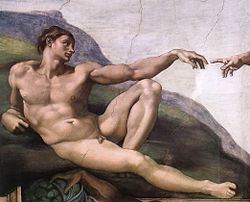 Detail from Michelangelo's The Creation of Adam, Sistine Chapel ceiling | |
| Spouse(s) | Biblical: Eve Extra-biblical: Lilith precedes Eve |
| Children | Biblical: Cain, Abel and Seth (three sons) Extra-biblical: Awan, Azura, and Luluwa or Aclima (three daughters) |
| Parent(s) | Northward/A |
| Adam | |
|---|---|
 A Byzantine mosaic in Monreale depicting Adam encountering the pre-incarnate Jesus at the Garden of Eden | |
| The Patriarch | |
| Built-in | Day 6, 1 AM Garden of Eden |
| Died | c. 930 AM |
| Venerated in | Christianity (Catholic Church building, Eastern Orthodox Churches, Oriental Orthodox Churches) Islam Druze[ane] [2] Baháʼí Religion Mandaeism |
| Feast | 24 Dec[three] |
| Patronage | Gardeners and tailors |
Adam [a] is the name given in Genesis ane-5 to the outset man.[4] Beyond its use equally the name of the first homo, adam is also used in the Bible as a pronoun, individually every bit "a human being" and in a commonage sense as "mankind".[four] Genesis 1 tells of God's creation of the earth and its creatures, including adam, meaning humankind; in Genesis 2 God forms "Adam", this time meaning a unmarried male human being, out of "the dust of the basis", places him in the Garden of Eden, and forms a adult female as his helpmate; in Genesis 3 Adam and the woman eat the fruit of the tree of knowledge and God condemns Adam to labour on the globe for his nutrient and to return to it on his death; Genesis four deals with the nascency of Adam's sons, and Genesis 5 lists his descendants from Seth to Noah.
The Genesis creation myth[b] was adopted by both Christianity and Islam, and the name of Adam appropriately appears in the Christian scriptures and in the Quran. He as well features in subsequent folkloric and mystical elaborations in later Judaism, Christianity, and gnosticism.
Limerick of the Adam narrative

In the unabridged Hebrew Bible Adam appears only in chapters 1–5 of the Book of Genesis, with the exception of a mention at the beginning of the Books of Chronicles where, as in Genesis, he heads the listing of State of israel's ancestors.[five] The majority view among scholars is that the final text of Genesis dates from the Persian period (the 5th and 4th centuries BCE),[6] but the absence of all the other characters and incidents mentioned in chapters ane–11 of Genesis from the rest of the Hebrew Bible has led a sizeable minority to the conclusion that these capacity were equanimous much later than those that follow, possibly in the 3rd century BCE.[vii]
Usage
Mankind—man beingness—male individual
The Bible uses the word אָדָם ( 'adam ) in all of its senses: collectively ("mankind", Genesis 1:27), individually (a "man", Genesis 2:7), gender nonspecific ("man and adult female", Genesis v:1–2), and male person (Genesis 2:23–24).[4] In Genesis 1:27 "adam" is used in the collective sense, and the interplay between the individual "Adam" and the commonage "humankind" is a principal literary component to the events that occur in the Garden of Eden, the ambiguous meanings embedded throughout the moral, sexual, and spiritual terms of the narrative reflecting the complication of the human condition.[8] Genesis 2:vii is the first verse where "Adam" takes on the sense of an individual man (the first human being), and the context of sex is absent-minded; the gender distinction of "adam" is then reiterated in Genesis five:1–2 by defining "male person and female".[four]
Connectedness to the earth
A recurring literary motif is the bond between Adam and the globe (adamah): God creates Adam by molding him out of clay in the final stages of the creation narrative. After the loss of innocence, God curses Adam and the earth as penalization for his disobedience. Adam and humanity are cursed to die and render to the globe (or ground) from which he was formed.[9] This "earthly" aspect is a component of Adam's identity, and Adam'due south curse of estrangement from the earth seems to depict humankind'due south divided nature of being earthly yet separated from nature.[ix]
In the Hebrew Bible
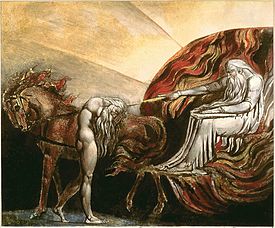
Genesis 1 tells of God's cosmos of the world and its creatures, with humankind as the last of his creatures: "Male person and female created He them, and blest them, and called their proper name Adam ..." (Genesis 5:2). God blesses mankind, commands them to "be fruitful and multiply", and gives them "rule over the fish of the sea, and over the fowl of the air, and over the cattle, and over all the earth, and over every creeping thing that creepeth upon the earth" (Genesis 1.26–27).
In Genesis 2, God forms "Adam", this time pregnant a single male homo, out of "the dust of the footing" and "breathed into his nostrils the breath of life" (Genesis 2:vii). God and then places this beginning man in the Garden of Eden, telling him that "Of every tree of the garden thou mayest freely eat: Simply of the tree of the knowledge of good and evil, thou shalt not swallow of it: for in the solar day that k eatest thereof thou shalt surely die" (Genesis 2:xvi–17). God notes that "It is not expert that the man should be lonely" (Genesis 2:18) and brings the animals to Adam, who gives them their names, merely amidst all the animals at that place was not constitute a companion for him (Genesis two:20). God causes a deep sleep to autumn upon Adam and forms a woman (Genesis two:21–22), and Adam awakes and greets her equally his helpmate.
Genesis 3, the story of the Fall: A serpent persuades the woman to disobey God'southward control and eat of the tree of knowledge, which gives wisdom. Woman convinces Adam to exercise likewise, whereupon they get conscious of their nakedness, cover themselves, and hibernate from the sight of God. God questions Adam, who blames the woman. God passes judgment, first upon the serpent, condemned to go on his belly, then the adult female, condemned to pain in childbirth and subordination to her husband, and finally Adam, who is condemned to labour on the globe for his food and to return to information technology on his death.[x] God and so expels the homo and adult female from the garden, lest they consume of the Tree of Life and become immortal.
The chiastic structure of the death oracle given to Adam in Genesis three:19 forms a link between man'south creation from "grit" (Genesis 2:7) to the "return" of his beginnings.[11]
- A you return
-
- B to the ground
- C since (kî ) from it y'all were taken
- C' for (kî ) dust you are
- B' and to dust
- B to the ground
-
- A' you will return
Genesis 4 deals with the birth of Adam's sons Cain and Abel and the story of the first murder, followed by the birth of a 3rd son, Seth. Genesis five, the Book of the Generations of Adam, lists the descendants of Adam from Seth to Noah with their ages at the nascence of their first sons (except Adam himself, for whom his historic period at the birth of Seth, his 3rd son, is given) and their ages at death (Adam lives 930 years, upto the 56th year of Lamech, father of Noah). The chapter notes that Adam had other sons and daughters after Seth, but does not name them.
Post-Biblical Jewish traditions
Trunk
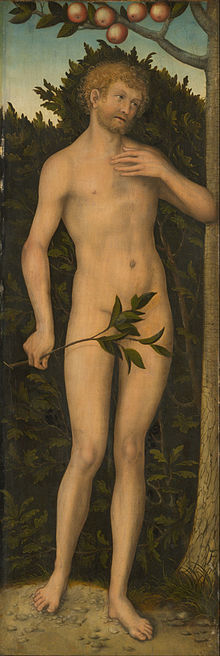
God himself took dust from all four corners of the globe, and with each color (cherry for the blood, black for the bowels, white for the bones and veins, and dark-green for the pale skin), created Adam.[12] The soul of Adam is the image of God, and as God fills the world, so the soul fills the man body: "as God sees all things, and is seen by none, so the soul sees, but cannot be seen; as God guides the world, so the soul guides the trunk; as God in His holiness is pure, so is the soul; and as God dwells in secret, and so doth the soul."[13] Co-ordinate to Jewish literature, Adam possessed a body of light, identical to the low-cal created by God on the offset day,[14] and the original celebrity of Adam can be regained through mystical contemplation of God.[15]
Adam, Lilith and Eve
The rabbis, puzzled past fact that Genesis 1 states that God created human being and woman together while Genesis ii describes them existence created separately, told that when God created Adam he too created a woman from the dust, as he had created Adam, and named her Lilith; but the two could non agree, for Adam wanted Lilith to lie nether him, and Lilith insisted that Adam should lie under her, and so she fled from him, and Eve was created from Adam's rib.[16] Her story was profoundly developed, during the Middle Ages, in the tradition of Aggadic midrashim, the Zohar and Jewish mysticism. Other rabbis explained the aforementioned verse every bit meaning that Adam was created with 2 faces, male person and female, or as a single hermaphrodite existence, male and female joined dorsum to back, but God saw that this made walking and conversing difficult, and so split them autonomously.[17]
Eve's error in the Fall
The snake approached Eve rather than Adam because Adam had heard the discussion of God with his ain ears, whereas Eve had only his report; Eve tasted the fruit and knew at in one case that she was doomed to death, and said to herself that it was ameliorate she trick Adam into eating and then that he also would die, and not take another woman in her place.[18] Adam ate the fruit unaware of what he was doing, and was filled with grief.[18] When Adam blamed Eve afterward eating the forbidden fruit, God rebuked him that Adam every bit a human being should non take obeyed his wife, for he is the head, not her.[19]
Adam and the winter solstice
An Aggadic legend establish in tractate Avodah Zarah 8a contains observations regarding the Roman mid-wintertime holidays and, the talmudic hypothesis that Adam the kickoff established the tradition of fasting before the winter solstice, and rejoicing afterward, which festival later devolved into the Roman Saturnalia and Calenda.
Children of Adam and Eve
Adam withdrew from Eve for 130 years after their expulsion from Eden, and in this time both he and Eve had sexual activity with demons, until at length they reunited and Eve gave birth to Seth.[16] A second-century BCE Jewish religious piece of work, the Book of Jubilees, tells how Adam had a daughter, Awân, born after Cain and Abel,[20] and another daughter, Azura, born afterwards Seth,[21] and they had nine other sons;[22] Cain married Awân and Seth married Azûrâ, thus accounting for their descendants. The Life of Adam and Eve and its Greek version the Apocalypse of Moses recount how Adam repented his sin in exile and was rewarded by beingness transported to the heavenly paradise, foreshadowing the destiny of all the righteous at the end of time.[15]
Adam'due south death and burial
The Archangel Michael attended Adam's death, together with Eve and his son Seth, still living at that time, and he was buried together with his murdered son Abel.[23] Because they repented, God gave Adam and Eve garments of low-cal, and similar garments will clothe the Messiah when he comes.[24]
Co-ordinate to the Apocalypse of Moses, which probably originates in first-century CE Jewish literature, the altar of the Temple of Solomon was the center of the world and the gateway to God's Garden of Eden, and information technology was hither that Adam was both created and buried.[25]
Attitude towards Adam
In the 17th-century book Kav ha-Yashar, the author warns non to talk negatively about Adam, and writes that those who talk positively near Adam volition be blessed with a long life.[26] A similar warning can be found in The Zohar.[27]
Adam and the angel Raziel
The Sefer Raziel HaMalakh (רזיאל המלאך) (Raziel the Angel) is a drove of esoteric writings, probably compiled and edited by the same hand, but originally not the work of one writer, which according to tradition was revealed to Adam by the affections Raziel. The book cannot be shown to predate the 13th century, simply may in parts date back to Late Antiquity, and similar other obscure ancient texts such as the Bahir and Sefer Yetzirah, it has been extant in a number of versions. Zunz ("G. 5." second ed., p. 176) distinguishes three main parts: (i) the Volume Ha-Malbush; (2) the Slap-up Raziel; (3) the Volume of Secrets, or the Volume of Noah. These three parts are however distinguishable—2b–7a, 7b–33b, 34a and b. After these follow two shorter parts entitled "Creation" and "Shi'ur Ḳomah", and subsequently 41a come formulas for amulets and incantations.[28]
In Christianity
Original sin
The idea of original sin is not institute in Judaism nor in Islam, and was introduced into Christianity by the Campaigner Paul, drawing on currents in Hellenistic Jewish thought which held that Adam's sin had introduced death and sin into the earth.[29] [30] Sin, for Paul, was a power to which all humans are subject, but Christ's coming held out the ways by which the righteous would be restored to the Paradise from which Adam'southward sin had banished flesh.[30] [15] He did non conceive of this original sin of Adam as beingness biologically transmitted or that afterwards generations were to exist punished for the deeds of a remote ancestor.[xxx] Information technology was Augustine who took this step, locating sin itself in male semen: when Adam and Eve ate of the fruit they were ashamed and covered their genitals, identifying the place from which the first sin was passed on to all succeeding generations.[31] Just Jesus Christ, who was non conceived past human semen, was free of the stain passed down from Adam.[32] (Augustine'south idea was based on the ancient world'southward ideas on biology, co-ordinate to which male person sperm contained the unabridged unborn baby, the mother's womb beingness no more a nurturing bedroom in which information technology grew.)[33]
Adam'southward grave: Golgotha replaces Solomon's Temple
Every bit mentioned above, the Apocalypse of Moses, a Jewish writing containing material probably originating from the beginning century CE, places both Adam'southward place of creation and his burial at the altar of the Temple of Solomon, seen equally the center of the world and the gateway to the Garden of Eden.[25] The early Christian community adapted this to their own legend of Golgotha, replacing the altar with the place of Jesus'south crucifixion.[34] According to this Christian fable, current in the fourth dimension of Origen (early 3rd century CE), the holy blood of Christ trickled down and restored to life the father of the human race, who then led the saints who appeared to many in Jerusalem on that day as described in Scripture.[35]
In Mandaeism
In Mandaeism, Adam is considered the founder of the organized religion and the first prophet. He heralds manda (knowledge) and the truthful path of enlightenment. He is viewed as the propagator of kushta or divine truth.[36] : 31, 45 According to the Mandaean agenda, 2021–2022 CE in the Gregorian agenda would correspond to the Mandaean year 445391 AA (AA = after the creation of Adam).[37]
In Gnosticism
In the ancient Gnostic text On the Origin of the Earth, Adam originally appears as a primordial existence born from light poured out by the aeon known as forethought. Accordingly, his primordial form is chosen Adam of Light. Merely when he desired to reach the eighth heaven, he was unable to because of the abuse mixed with his calorie-free. Thus he creates his ain realm, containing six universes and their worlds which are seven times better than the heavens of Chaos. All these realms exist inside the region between the eighth sky and the Anarchy beneath it. But when the archons saw him, they realize the primary creator of the material world (Yaldabaoth) had lied to them past claiming he was the merely god. However, they decide to create a physical version of Adam in the image of the spiritual Adam. Just Sophia later sends her girl Zoe (the spiritual Eve) to give the concrete Adam life before leaving the concrete Eve with Adam and inbound the Tree of Knowledge. However, according to the Hypostasis of the Archons, a spirit descends on the physical Adam and gives him a living soul.[38]
In Islam

Adam and Eve, Manafi al-Hayawan (The Useful Animals), Maragheh, Iran, 1294–99
In Islam, God created Adam (Standard arabic: آدم) from a handful of globe taken from the unabridged world, which explains why the peoples of the world are of different colours.[39] According to the Islamic creation myth, he was the start prophet of Islam and the first Muslim. The Quran says that all the prophets preached the same religion of submission to God. When God informed the angels that he would create a vice-regent (a khalifa) on Globe, the angels enquired, saying, "will You place therein such that will spread corruption and bloodshed?" So God showed the angels, proverb, "Tell Me the names of these?" The angels had no noesis of these, as God had not taught them. Then God immune Adam to reveal these names to them, saying, "Did I not say to you (angels) that I know what is unseen in the heavens and the globe and I know what y'all (angels) reveal and what you lot (Satan) conceal;" the scholar Al-Tabari explained that God was referring to Iblis (Satan) of his evil plans and to the angels of their honesty.[40]
Adam and Eve both ate of the Tree of Immortality, and both shared guilt equally, for Eve neither tempted Adam or ate before him; nor is Eve to blame for the hurting of childbirth, for God never punishes one person for the sins of another.[ citation needed ] The Shia school of Islam does non even consider that their activity was a sin, for obedience and defiance are possible simply on Earth, and not in heaven where the paradise is located.[ citation needed ]
Adam fell on a Adam'south Summit mountain located in central Sri Lanka, the tallest in the earth and and so the closest to Sky, and from there God sent him to Mecca, where he repented and was forgiven.[41] At Mecca he built the showtime Sanctuary (the Kaabah – it was afterwards rebuilt by Ibrahim) and was taught the ritual of the Hajj, and wove the first cloak for himself and the offset veil and shift for Eve, and afterwards this returned to India where he died at the age of 930, having seen the sons of the sons of his children, 1400 in all.[42]
According to the Ahmadiyya sect Adam was not the offset man being on earth, but when the human race came into being, and spread all over the earth and adult the ability to receive revelation, God sent Adam to each and every co-operative of civilization. According to a revelation received past Mirza Ghulam Ahmad, the founder of the community, the Adam mentioned in the Quran was built-in four,598 years earlier Muhammad.[43]
The Muslim thinker Nasir Khusraw offers another interpretation of Adam's significance to the Islamic religious tradition. He writes that Adam was the get-go enunciator of divine revelation (nāṭiq) and Seth was his legatee (wasī). He argues that the descendants of Seth are Imams, culminating in the seventh Imam, Nuh/Noah who, in add-on to holding the Imamate, would also hold the position of enunciator.[44]
In the Islamic traditions (hadith), Adam is given the name by God known every bit the (Adam-I-Safi) or The Chosen One.[45] [46]
In Druze religion
The Druze regard Adam every bit the first spokesman (natiq), who helped to transmit the foundational teachings of monotheism (tawhid) intended for a larger audience.[47] He is besides considered an important prophet of God in Druze organized religion, beingness amongst the 7 prophets who appeared in dissimilar periods of history.[1] [2]
See besides
- Adam's grave or burial site of his skull
- Cave of Machpelah in Hebron; according to traditional Jewish conventionalities
- Temple of Solomon; according to the Jewish volume, the Apocalypse of Moses
- Golgotha; now Adam'south Chapel in the Church building of the Holy Sepulchre, Jerusalem; according to Christian tradition based on the Apocalypse of Moses
- Monastery of the Cantankerous in Jerusalem; according to Christian tradition
- Imam Ali Mosque in Najaf; according to Shia tradition, after Noah buried him in that location following the deluge.
- Adam–God doctrine
- Adam Kadmon
- Adam kasia
- Adam pagria
- Adapa
- Banu (Arabic)
- Eve
- Listing of Former Testament pseudepigrapha
- Life of Adam and Eve
- Apocalypse of Adam
- Testament of Adam
- Books of Adam
- Conflict of Adam and Eve with Satan
- Mahabad (prophet)
- Manu
- Paradise Lost
- Table of prophets of Abrahamic religions
- Y-chromosomal Adam
Notes
- ^ Hebrew: אָדָם, Modern: ʼAdam , Tiberian: ʾĀḏām ; Aramaic: ܐܕܡ; Arabic: آدَم, romanized: ʾĀdam ; Greek: Ἀδάμ, romanized: Adám ; Latin: Adam
- ^ "Creation myths are symbolic stories describing how the universe and its inhabitants came to be. Creation myths develop through oral traditions and therefore typically take multiple versions." See Womack, p.81, in bibliography.
References
Citations
- ^ a b Hitti, Philip K. (1928). The Origins of the Druze People and Religion: With Extracts from Their Sacred Writings. Library of Alexandria. p. 37. ISBN9781465546623.
- ^ a b Dana, Nissim (2008). The Druze in the Middle East: Their Organized religion, Leadership, Identity and Status. Michigan Academy press. p. 17. ISBN9781903900369.
- ^ The Slaves of the Immaculate Heart of Mary (24 December 2000). "Saint Adam and Saint Eve (Offset Historic period of the world)". Catholicism.org . Retrieved 22 December 2021.
- ^ a b c d Hendel 2000, p. xviii.
- ^ Enns 2012, p. 84.
- ^ Cosgrove 2004, p. 168.
- ^ Gmirkin 2006, pp. 240–241.
- ^ Hendel 2000, p. xviii-19.
- ^ a b Hendel 2000, p. 119.
- ^ Mathews 1996, p. 252
- ^ Mathews 1996, p. 253
- ^ Ginzberg 1909, vol I, affiliate Ii.
- ^ Ginzberg 1909, vol I, chapter II
Citation: "God had fashioned his (Adam'south) soul with particular care. She is the image of God, - ^ Schwartz 2006, p. 130.
- ^ a b c Hendel 2000, p. xix.
- ^ a b Schwartz 2006, p. 218.
- ^ Schwartz 2006, p. 138.
- ^ a b Schwartz 2006, p. 434-435.
- ^ Ginzberg 1909, p. 36-37.
- ^ Jubilees iv:1.
- ^ Jubilees 4:9
- ^ Jubilees 4:10
- ^ Schwartz 2006, p. 445.
- ^ Schwartz 2006, p. 437.
- ^ a b Ginzberg 1998, p. 125-126.
- ^ Parshat Chukat
- ^ Zohar Chadash Parshat Beresheit 24a or in older versions 19
- ^ "Raziel, Volume of". Jewish Encyclopedia (1906).
- ^ Pies 2000, p. xviii.
- ^ a b c Dull 2012, p. 301.
- ^ Stortz 2001, p. 93.
- ^ Stortz 2001, pp. 93–94.
- ^ Stortz 2001, p. 94.
- ^ Ginzberg 1998, p. 126.
- ^ Hanauer 2011, pp. 69–lxx.
- ^ Brikhah S. Nasoraia (2012). "Sacred Text and Esoteric Praxis in Sabian Mandaean Religion" (PDF).
- ^ Gelbert, Carlos (2005). The Mandaeans and the Jews. Edensor Park, NSW: Living Water Books. ISBN0-9580346-two-1. OCLC 68208613.
- ^ Marvin Meyer; Willis Barnstone (June 30, 2009). "On the Origin of the World and The Reality of the Rulers (The Hypostasis of the Archons)". The Gnostic Bible. Shambhala. Retrieved 2021-ten-17 .
- ^ Wheeler 2002, pp. 17–xviii.
- ^ Wheeler 2002, p. 15.
- ^ Wheeler 2002, p. 25,30.
- ^ Wheeler 2002, p. 32,39,43.
- ^ "Man Lived on World Even Earlier the Advent of Adam". Al Islam. 2000-02-16.
- ^ Virani, Shafique. "The Days of Creation in the Thought of Nasir Khusraw". Nasir Khusraw: Yesterday, Today, Tomorrow.
- ^ Ridgeon, Lloyd (2010). "Shaggy or Shaved? The Symbolism of Pilus amidst Persian Qalandar Sufis". Iran and the Caucasus. 14 (2): 12. doi:10.1163/157338410X12743419190142.
Adam was given the honorary proper noun of "Adam-I-Safi" meaning: The Chosen One
- ^ Anand, Thou.D.W. "The Christ of the Quran" (PDF). biblicalstudies.org.uk. p. 57.
Adam was God's Chosen one "Adam-Safi"
- ^ Swayd 2009, p. 3.
Bibliography
- Ho-hum, Eugene (2012). An Introduction to the New Testament: History, Literature, Theology. Westminster John Knox. ISBN9780664255923.
- Cosgrove, Charles H. (2004). The Meanings Nosotros Cull: Hermeneutical Ethics, Indeterminacy and the Conflict of Interpretations. Bloomsbury Publishing. ISBN978-0-567-06896-five.
- Enns, Peter (2012). The Evolution of Adam: What the Bible Does and Doesn't Say nearly Human Origins. Bakery Books. ISBN9781587433153.
- Ginzberg, Louis (1998). The Legends of the Jews: From the Cosmos to Exodus: Notes for Volumes 1 and ii. JHU Printing. ISBN9780801858949.
- Ginzberg, Louis (1909). The Legends of the Jews (PDF). Translated by Henrietta Szold. Philadelphia: Jewish Publication Society.
- Gmirkin, Russell E. (2006). Berossus and Genesis, Manetho and Exodus. Bloomsbury. ISBN9780567134394.
- Hanauer, J.Eastward. (2011). Sociology of the Holy Land. The Other Press. ISBN9789675062568.
- Hendel, Ronald S (2000). "Adam". In David Noel Freedman (ed.). Eerdmans Dictionary of the Bible. Eerdmans. ISBN9789053565032.
- Mathews, Chiliad. A. (1996). Genesis 1–11:26. B&H Publishing Group. ISBN978-0805401011.
- Pies, Ronald W. (2000). The Ideals of the Sages: An Interfaith Commentary on Pirkei Avot . Jason Aronson. ISBN9780765761033.
- Schwartz, Howard (2006). Tree of Souls: The Mythology of Judaism. Oxford University Printing. ISBN9780195327137.
- Stortz, Martha Ellen (2001). "Where or When Was Your Servant Innocent?". In Bunge, Marcia J. (ed.). The Child in Christian Idea. Eerdmans. ISBN9780802846938.
- Wheeler, Brannon K. (2002). Prophets in the Quran: An Introduction to the Quran and Muslim Exegesis. A&C Blackness. ISBN9780826449573.
- Womack, Mari (2005). Symbols and Meaning: A Curtailed Introduction. AltaMira Printing. ISBN978-0-7591-0322-ane.
- Swayd, Samy South. (2009). The a to Z of the Druzes. ISBN9780810868366.
External links
Source: https://en.wikipedia.org/wiki/Adam
0 Response to "One Day to Live They Too Will Fall to Earth Again Georgia B Adams"
Post a Comment